West Africa – now hosting the biggest of ships
Dynamar has just released its latest edition of the West Africa Container Trades, a biennial survey of shipping services, carriers and ports active along all West Africa’s routes.
Since the first edition of 2012, the West Africa container trades have seen many changes, not the least the development and now maturation of a fully functioning and organic hub and spoke system. This has come about with the commissioning of modern container terminals able to handle the very largest ships.
The ultimate expression of this has been demonstrated by MSC which has routed its Tiger service on the return trip from the Mediterranean via West Africa ports before continuing on the Indian Ocean. The Tiger includes vessels in excess of 24,000 TEU and its new itinerary is surely a vote of confidence in West Africa’s ports; if they were not able to handle these ships, they would not call.
Nigeria – a return to the top
This is all a far cry from 2014-15 when West Africa trades specialist NileDutch received a series of four ships of 3,500 TEU. They were ordered and designed with the deepsea West Africa trades in mind but by the time of their delivery, they were already small for the key Asia route for which they were intended. By then, the first of West Africa’s new hub terminals, the Lome Container Terminal in Togo, had just been commissioned. With subsequent facilities developed and delivered in Tema (Ghana), Abidjan (Ivory Coast) and more recently Kribi (Cameroon), ships well in excess of 10,000 TEU – as we have seen – are now a common sight in the region’s ports.
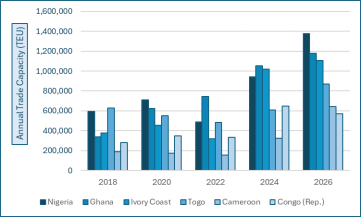
Yet it is not just these hub ports that have seen development. Lekki in Nigeria was commissioned in 2023 and seems to have taken some pressure off Lagos. As a result, and as the survey for this 2026 edition of the West Africa Container trades shows, the Annual Trade Capacity that carriers send to Lagos has shot up for two surveys in a row. Furthermore, investments and interest in east Nigerian port facilities have also increased, as has the carrier patronage of them. These developments have combined to see Nigeria, the economic powerhouse of the region, return to the top of the Annual Trade Capacity table, a position it last occupied in the 2020 edition.
Leading West Africa countries by Annual Trade Capacity (2026)
MSC – a new name at the top
However, whilst Nigeria’s ports are primarily gateway orientated, Ghana, Ivory Coast and Cameroon are homes to ports with a significant local and/or regional hub function. Whatever the reason for the activity, it is clear that the amount of trade capacity coming into West Africa is growing, and quickly. This is driven by the twenty-one shipping lines who call the coastline directly with their own vessels. Although there are two extra carriers when compared with the 2024 survey, over eighty percent of the capacity is generated by just four carriers. These are led by MSC which accounts for over one third on its own.
MSC being the largest carrier (by Annual Trade Capacity) is a new development as Maersk had been the long-time leader. However, the combination of Maersk’s rationalisation along the trade plus the increase in MSC’s capabilities, this pushed by not only by the redirection of the Tiger service but also increases on other services and trade lanes, have led to the change. Even so, Maersk is still the second largest and provides over one fifth of all Annual Trade Capacity.
Trade lanes – a relationship moving east
There are eight trades that are connected to West Africa without the need for transhipment, although this also includes a connection that is, ironically, transhipment based, namely the Mediterranean Relay trade. This is anchored on recognised hub ports located within the Mediterranean or Canary Islands and move cargoes that will have come from all over the world.
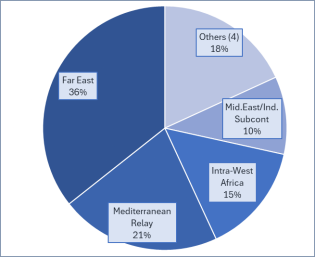
What is clear, though, is that the centre of West Africa’s container shipping activity is moving ever eastwards with Asia and the Middle East/Indian Subcontinent now the most important intercontinental routes. In between them are the Mediterranean Relay and the intra-West Africa trades with North Europe and Mediterranean (gateway) very much removed.
Leading West Africa container trades by Annual Trade Capacity (2026)
Looking forward – threats and opportunities
Of those main routes, the Mediterranean Relay route could be under most threat. With the improved capabilities of West Africa ports, and with more promised, and their proven ability to host not only the biggest ships but also a growing regional network, the economic attractiveness of shipping indirectly via
the Mediterranean hubs might weaken. This is particularly the case for destinations located in the Gulf of Guinea and southern Atlantic aspects and for origins to the east. For North Atlantic destinations, and origins to the north and west (i.e. Europe and the Americas), the ‘transhipment via Mediterranean’ route will retain its relevance.
There is also an opportunity that could arise from a stable Middle East and in particular, Red Sea situation. If container carriers feel confident enough to return to Red Sea-Suez transits, this will free up many ships of considerable capacity. They will need employment and West Africa has shown, it is willing and, crucially, able to handle them.
Dynamar’s biennial West Africa Container Trades series is now in its eighth edition. As well as Annual Trade Capacity modelling, it analyses the carriers, trades and ports that feature in the West Africa container shipping sector. The results are also placed in context to show how the specific trade lanes, carriers and ports have evolved. Underlying the container shipping results, further context is provided by the terminal operators that are present and their West Africa portfolios, the region’s economy, merchandise trade and national summaries, giving a texture and colour to this always fascinating coastline. For further details please see https://dynamar.com/our-sector-reports/ or container This email address is being protected from spambots. You need JavaScript enabled to view it..
Source, Dynamar